
Utah on the American Discovery Trail
Utah · Shared Route
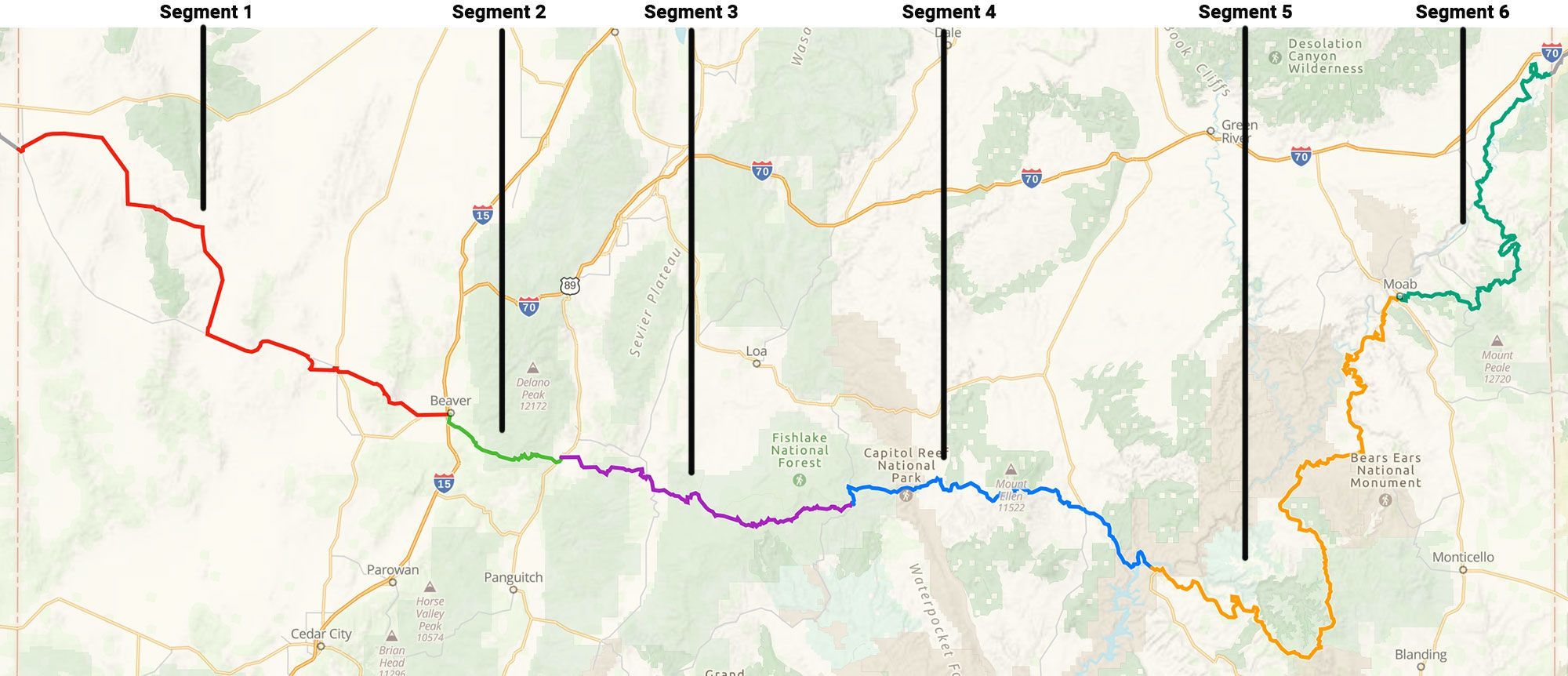
Utah is 592.6 miles of the American Discovery Trail, between the Nevada line on UT 21 and the Kokopelli Trail junction in Rabbit Valley at the Colorado line. Both branches of the trail share every mile. The low ground is 3,689 feet at the Hite Crossing Bridge over the Colorado River. The high ground is 10,563 feet on Bull Creek Pass Road in the Henry Mountains, 41.9 trail miles from the bridge.
Six segments cover Great Basin desert, the Tushar Mountains, the highest timbered plateau in North America, Capitol Reef, the last mountain range added to the map of the lower 48, Canyonlands, and 110 miles of the Kokopelli Trail. Garrison, Milford, Beaver, Circleville, and Moab are the only towns on the line.
↓ Download the PDF segment guidesSegment Guides
The West Desert: Garrison to Milford
Garrison sits about half a mile south of the western end of Segment 1, with a post office, an elementary school, and a working water pump at the playground. The next reliable water is Milford, 91 miles away. Nothing in between holds up: Squaw Spring is an algae-covered seep in most years, and the cattle troughs and stock ponds along Garrison Black Rock Road depend on whether anyone is running cows. Hikers cache water through this stretch, and the guide carries coordinates for sites that have worked plus the contact for the volunteer who buries caches by arrangement each spring. The Garrison post office cannot accept UPS, FedEx, or Amazon, so a resupply box there has to move by USPS.
Crystal Peak Pass at 6,226 feet is the high ground on the western half, named for the quartz, sanidine, and plagioclase that make the mountain sparkle, with dispersed camping for half a mile on either side. Wah Wah Valley is 30 miles of open basin below 5,300 feet with a working ranch on the line and long views down to Antelope Peak.
Frisco
Frisco sits at 6,378 feet on the eastern half of Segment 1, a silver camp founded in 1875 around the Horn Silver Mine. At its peak it held roughly 6,000 people and 23 saloons, and the local newspaper editor described it as Dodge City, Tombstone, Sodom and Gomorrah all rolled into one. The Horn Silver caved in on February 12, 1885 and the town was empty by 1920. Five granite beehive charcoal kilns built between 1877 and 1880 still stand up a short side road north of the route, on the National Register since 1982, along with mill ruins and a cemetery. A historical marker and a covered picnic table are on the line, and it is a proven cache site.
Milford has a full grocery, a post office that accepts general delivery, two motels, a 24-hour diner, a city campground with water hydrants and a covered pavilion, and an Amazon counter inside the hardware store. Soldier Pass at 7,451 feet is the segment high point, east of Milford, with Granite Peak Reservoir about 20 minutes off the line up a side trail from the cattle guard. Cherry Creek runs along the south side of the road below the pass and is one of the few fairly reliable sources in the segment's eastern third.
Beaver and the Tushar Mountains
Segment 2 is 28.3 miles, the shortest in Utah, and it carries 3,675 feet of relief between Beaver at 5,906 feet and a 9,581-foot crossing of the Tushars in the Fishlake National Forest. Beaver puts everything on the route: post office, library, laundromat, grocery, motels, restaurants, a public restroom by the post office. Robert LeRoy Parker was born here in 1866 and became Butch Cassidy. Philo T. Farnsworth, who held the first patent on fully electronic television, was born in a log cabin nearby in 1906; the cabin was moved next to the old Beaver County courthouse, where a bronze statue of him also stands.
South Creek Road and the South Fork hold the western half, with Birch Creek, Wildcat Creek, and Middle Creek as the water. The Little Twist Fire burned Trails 243 and 66 in 2024 and a prescribed burn followed. Field reports from October 2025 describe tread that is easy to follow in places and then vanishes, waist-high regrowth, and slopes with nothing left holding the soil.
Boulder Mountain and the Great Western Trail
Circleville sits at 6,090 feet in Circle Valley, ringed by mountains except where the Sevier River enters and leaves, with lodging, food, and a post office. Butch Cassidy's boyhood cabin stands 2.5 miles south of town on US 89, visible from the highway and free to walk through. Segment 3 is 74.1 miles between Circleville and UT 12. Its steepest ground is a 4.3-mile pitch above Poison Creek at a 10.2 percent average grade, 2,293 feet of gain, with the creek reliable for most of that climb. Antimony Creek, Big Swale Reservoir, and a chain of forest roads cross the interior.
The eastern two thirds of the segment ride the Great Western Trail across Boulder Mountain, the eastern half of the Aquarius Plateau and the highest timbered plateau in North America, with more than 50,000 acres above 11,000 feet and better than 80 lakes on top. The route holds 9,500 to 10,000 feet through here past McGath, Cuddyback, and Bowns lakes and a string of creek crossings. Field reports describe faint tread that depends on cairns, a mile of blowdowns east of one cairn field that cuts pace below one mile an hour, and mosquitoes thick enough in spring and early summer to warrant long sleeves and repellent. The Escalante District office of the Dixie National Forest is the number to call for conditions. The route is not a winter proposition and turns to deep mud in heavy rain.
Capitol Reef and the Henry Mountains
Segment 4 is 88.6 miles and holds both ends of Utah's elevation range. Spruce Spring is piped and flowing at the western end at 9,549 feet. Oak Creek canyon carries the route through Capitol Reef National Park, where the walls pinch tight enough to force more than two dozen creek crossings, past a waterfall and a natural arch. Camping outside established campgrounds in the park needs a backcountry permit, free and issued in person at the visitor center during business hours.
The Henry Mountains fill the middle of the segment on Henry Mountains Road, Nasty Flat Road, and Bull Creek Pass Road, a 68-mile backcountry scenic byway. The Henrys were the last mountain range added to the map of the lower 48, surveyed and named in 1872, and before that they showed up on maps as the Unknown Mountains. A free-roaming herd of a few hundred genetically pure plains bison lives here, descended from 18 animals moved out of Yellowstone in 1941, and in summer they work the high country around Mount Ellen. The high point of the entire Utah crossing is 10,563 feet on Bull Creek Pass Road below Mount Ellen. South Creek is fairly reliable on the western approach; Granite Creek and Crescent Creek are not.
UT 95 holds the eastern quarter. Hanksville is 26 miles north of the route at the UT 276 junction, and hitching works there because nearly every vehicle coming off Bullfrog Marina stops at that junction and turns north with no other turnoff for the whole run. Hog Springs has a rest area and picnic ground on the line. Hite has a boat ramp, an airstrip, and an overlook, but no services: the concession lapsed in 2021 and the National Park Service closed its developed area in January 2024 pending a new takeout ramp and a new contract.
Hite Crossing Bridge
The Hite Crossing Bridge carries UT 95 over the Colorado River at 3,689 feet, the lowest ground in Utah on the route. It is a single steel arch, opened June 3, 1966, roughly 200 feet above the water, and the only automobile crossing of the Colorado for about 295 miles, with the next bridges 110 miles upstream at Moab and 185 miles downstream at Glen Canyon Dam. Two lanes, no shoulder, no pedestrian lane. The Dirty Devil River bridge sits a mile west of it.
Elk Ridge, Beef Basin, and Canyonlands
Segment 5 is 174.5 miles, the longest in Utah. Fortknocker Canyon Road and Woodenshoe Road hold the western end out of the Colorado River corridor and into Bears Ears National Monument, up onto Elk Ridge at 8,000 to 9,262 feet in the Manti-La Sal National Forest. The Notch, Duck Lake, Arch Canyon Overlook, and the Dark Canyon East trailhead sit along that ridge, with the Kigalia and Gooseberry guard stations a short walk off the line. Water up there is stock ponds and a few springs. Thirty miles of the Elk Ridge road surface turn to a paste that stops hikers, not only vehicles: moderate rain costs half a day, and a real storm costs one or two.
Beef Basin and Ruin Park hold the densest ancestral Puebloan sites on the route. Tower Ruin stands on a narrow ledge partway up a canyon wall, the masonry fragile enough that it should not be touched or climbed. Pappy's Pasture holds a low stone outline, probably a partly reconstructed pithouse, in open grassland with a heritage sign. Structures are visible for roughly 3 miles through Ruin Park. Bobby's Hole Dugway connects Beef Basin to Butler Flat in 1.6 miles of steep, narrow switchbacks, the most technical ground in the segment.
The Needles District of Canyonlands National Park covers the middle of the segment on Elephant Hill Road and Needles Main Park Road. Backcountry camping requires a permit, $15 and good for 14 days, reserved through Recreation.gov no more than four months and no less than two days out, and spring and fall demand routinely runs past supply. Every person entering the park on foot pays the entrance fee. The last legal dispersed camping outside the permit system is on BLM ground at the park boundary. Horsehoof, Bobby Jo, and Devil's Kitchen campgrounds are inside the park, and the Needles Visitor Center has water, toilets, and power. The Needles Outpost campground is 0.62 miles north of the line.
Lockhart Basin Road runs about 40 miles between the park and Kane Creek at 4,000 to 4,300 feet, crossing washes that regularly erase the road and one confluence of two washes that makes a genuinely confusing junction. Chicken Corners is a dead-end spur off the route with a view north across the Colorado to the cliff used for the final scene of Thelma and Louise. Hurrah Pass meets the route at the Kane Creek junction. The last 15 miles into Moab follow Kane Springs Road and Kane Creek Boulevard past the Birthing Scene petroglyph panel, Funnel Arch, and a line of BLM ledge campgrounds. Springs along lower Kane Creek are the most dependable water in the segment's eastern third.
Moab, the La Sals, and the Kokopelli Trail
Moab has everything, at 4,045 feet on the Colorado. Segment 6 covers 110.4 miles from the middle of town to a state line that is 16 miles away in a straight line. The Kokopelli Trail accounts for the difference.
Sand Flats Recreation Area holds the first miles out of town, past eight numbered campgrounds, the Slickrock Trail trailhead, and the Porcupine Rim trailhead, gaining about 2,160 feet in the first 6 miles on Sand Flats Road. Above that the route joins Kokopelli's Trail, the 142-mile route between Loma, Colorado and Moab built in 1989 by the Colorado Plateau Mountain Bike Trail Association with the BLM and the Forest Service, and named for the flute player of Colorado Plateau tradition. The American Discovery Trail rides it for the rest of Utah, and Colorado Segment 1 picks it up again on the far side of the line.
La Sal Loop Road and Taylor Flat Road cross the north end of the La Sal Mountains in the Manti-La Sal National Forest, past the Castle Valley Overlook, the Miner's Basin trailhead, a large aspen stand that turns in the fall, and the segment high point at 8,628 feet. Rock Castle, Mason Draw, Fisher Valley, and Onion Creek Hideout campgrounds are on or near the line. Rose Garden Hill Trail is the steepest ground in Utah, a 32.2 percent pitch near 5,245 feet with a second at 25.6 percent above it. Top of the World Road runs the ridge over it, and Cottonwood Cutoff and Shura Road reach UT 128 at the Colorado River, where Cowskin Campground and a vault toilet sit near the highway. The river is silty enough that field reports advise letting it settle or treating it with alum before it goes through a filter, and the undertow makes swimming without a life jacket a bad idea.
Four miles of paved UT 128 replace the Yellow Jacket Canyon section of the Kokopelli, cutting 9.9 miles of deep sand and rock that most bikers skip as well. This is one of the few places the American Discovery Trail bypasses part of an affiliate trail. The eastern 39 miles are BLM two-track and Kokopelli tread across Fish Ford, Agate, and Westwater, crossing seasonal Westwater Creek and passing a Denver and Rio Grande Western trestle, with Arch Junction, the Western Rim, and Zion Curtain trails branching off. Water there is seasonal at best, and proven cache sites are marked in the guide. Rabbit Valley at 4,817 feet is the state line, where Utah Segment 6 ends and Colorado Segment 1 begins on the same tread.
Alternates
The guide carries three alternates across the six segments. UT 21 into Milford is a 2.36-mile shortcut on pavement instead of two-track. The UT-2 alternate in Segment 2 routes around the Little Twist burn on Trails 243 and 66 and is the recommended line until that tread recovers. The Babylon Fire alternate in Segment 5 replaces 74.7 official miles with 39.1 and carries a CC BY-NC-SA 4.0 license. All three are in the turn-by-turn with full waypoints in the GPS data.
Timing and Terrain
The desert ends work on one calendar and the mountains work on another. Garrison to Milford in the west, and Hite through Moab and the Kokopelli in the east, run past 100 degrees in July with no shade and almost no water, which makes spring and fall the working months at both ends. The Tushars, Boulder Mountain, and the Henrys hold snow into June and start collecting again in September, and the 10,000-foot miles on Boulder Mountain are shut in winter. The overlap between those two windows is narrow, and most hikers accept a compromise on one end of the state. Rain sets its own limits: Elk Ridge and the Beef Basin roads become impassable when wet, Lockhart Basin's washes flash, and the Boulder Mountain forest roads turn to mud that holds for days.
Water, Resupply, and Camping
The 91 miles between Garrison and Milford have no reliable source, and caching is standard practice through there. The mountain segments are the reverse: Poison Creek, West Branch Pine Creek, Oak Creek, and the Boulder Mountain lakes run dependably, and Spruce Spring is piped. Segment 5 goes thin again, with stock ponds and unreliable springs across Elk Ridge and Beef Basin before the Kane Creek springs. Segment 6 water is seasonal, and the Colorado at UT 128 needs to settle before filtering.
Milford, Beaver, and Moab have full groceries and post offices that accept general delivery with notice. Garrison has a post office, a water pump, and nothing else. Circleville has lodging, food, and a post office. Hanksville is a 26-mile hitch off UT 95, and Hite has nothing. Between Circleville and Moab, 337.2 trail miles across Segments 3, 4, and 5, there is no town on the line at all.
Camping is mostly easy and mostly public. BLM ground across the west desert, the Fishlake and Dixie national forests, the Manti-La Sal, and the BLM Moab and Monticello field offices all allow dispersed camping along most of the corridor, and our notes carry specific sites with field dates. The exceptions matter: Capitol Reef requires a free backcountry permit, Canyonlands requires a paid one reserved in advance, and Glen Canyon National Recreation Area has its own rules through the Hite corridor. Sand Flats charges a fee, and its campgrounds are the legal option on the way in and out of Moab.
What a Utah Crossing Looks Like
592.6 miles, six segments, and 6,874 feet between the lowest ground and the highest. Segment 1 is 91 waterless miles of Great Basin desert and a ghost town that once had 23 saloons. Segment 2 is 28 miles over the Tushars through a burn scar. Segment 3 holds the highest timbered plateau in North America and a mile of blowdowns. Segment 4 runs a canyon into Capitol Reef, crosses the last range mapped in the lower 48, and finishes on a bridge 200 feet above the Colorado. Segment 5 is 174 miles with ancestral Puebloan ruins, one road, and Canyonlands. Segment 6 spends 110 miles of Kokopelli Trail to cover 16 miles of map. Both branches of the trail use every one of these miles. 🥾⛰️